
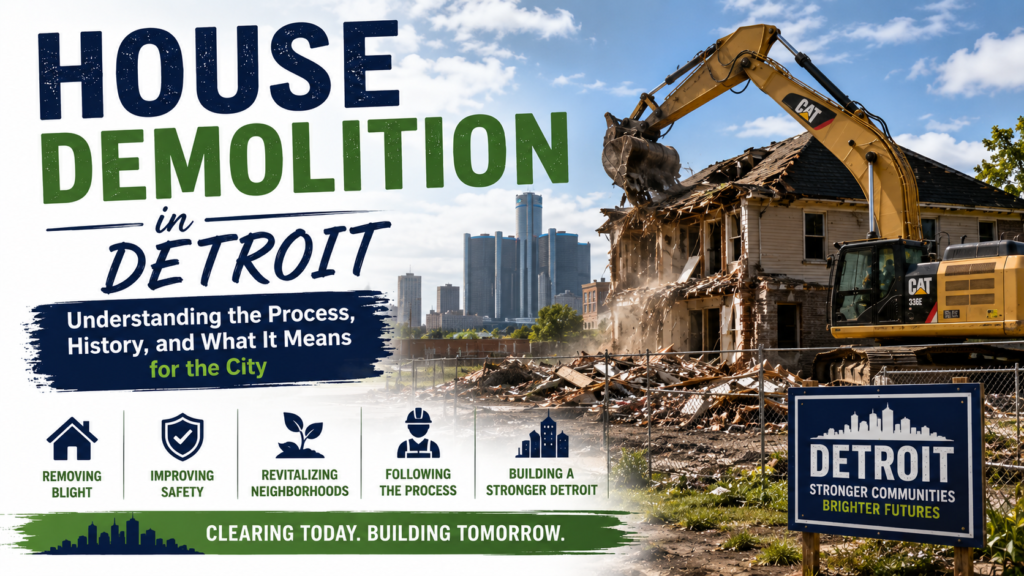
Detroit has one of the most documented and substantial residential demolition histories of any American city. Over the past decade and a half, the city has undertaken the removal of tens of thousands of vacant and blighted homes, reshaping entire neighborhoods and changing the way residents, city planners, and contractors think about demolition as a public service and a private undertaking. For property owners, developers, and community members navigating House Demolition Detroit today, understanding the full scope of what this work involves, from regulatory requirements to environmental protections and post-demolition site preparation, is essential.
Detroit’s Demolition Landscape: Context That Matters
To understand house demolition in Detroit, it helps to understand the city’s broader trajectory. Detroit experienced dramatic population loss beginning in the latter half of the twentieth century, leaving behind a large inventory of vacant, abandoned, and deteriorating residential structures. By 2014, the city had an estimated 47,000 abandoned Land Bank-owned homes. This scale of blight created public safety hazards, depressed surrounding property values, and contributed to neighborhood instability.
The city responded with one of the most aggressive urban demolition programs in American history. Through federally funded phases and the voter-approved Proposal N bond program, Detroit removed more than 27,000 houses over a twelve-year period. By late 2025, the Detroit Land Bank had fewer than 1,000 abandoned homes remaining, compared to the staggering inventory that existed a decade earlier. This effort has been credited with contributing to a measurable increase in surrounding home values, with generational wealth gains estimated in the billions of dollars for longtime Detroit homeowners.
What House Demolition in Detroit Actually Involves
Whether it is a private property owner, a developer, or a city-initiated program, house demolition in Detroit follows a well-defined sequence of steps designed to protect workers, neighbors, and the environment.
Pre-Demolition Assessment and Planning
Before any physical work begins, a thorough assessment of the structure is required. Contractors evaluate the age of the building, construction materials, structural condition, and the presence of any hazardous materials. In Detroit, many residential structures date to the first half of the twentieth century, which means they frequently contain asbestos in insulation, pipe wrapping, floor tiles, and other building components, as well as lead-based paint. Identifying these materials before demolition begins is not simply best practice; it is a legal requirement.
Utility Disconnection
All utilities serving the structure, including gas, electricity, water, and sewer connections, must be formally disconnected and capped before demolition can begin. In the city-run program, this step alone can take ninety days or more, as it involves coordination with multiple public utilities. For private demolitions, property owners work with utility companies to complete disconnection in advance of the permitted demolition date. Disconnecting utilities is a critical safety step that prevents fires, explosions, or environmental contamination during the teardown.
Hazardous Material Abatement
Detroit’s demolition standards require that all safely accessible asbestos be removed from structures prior to demolition. This is handled by certified abatement contractors who follow EPA and Michigan Department of Environment, Great Lakes, and Energy protocols. Lead paint is also addressed during this phase. The city of Detroit has been recognized by the US Environmental Protection Agency for its demolition program environmental standards, which balance speed of execution with rigorous protections for residents and workers.
Neighbor Notification
Under Detroit’s demolition requirements, contractors must post door hangers on neighboring properties at least three days before demolition begins. This notification informs residents of the upcoming activity and provides guidance on steps they can take to minimize exposure to dust or debris. This practice reflects Detroit’s recognition that demolition in dense urban neighborhoods affects more than just the property being torn down.
Demolition and Dust Control
The physical demolition of a house typically involves mechanical methods using excavators, hydraulic attachments, and other heavy equipment. Detroit’s demolition standards require that structures be sprayed with water before and during demolition to suppress dust, and that debris be sprayed again as it is loaded and hauled away. Dust control is a significant public health consideration in a city with historically elevated rates of respiratory illness. Contractors operating without dust control measures face serious penalties under Detroit’s program.
Debris Removal and Site Cleanup
After the structure is down, all debris is removed from the site. Material sorting for recycling is part of responsible demolition practice, with concrete, metal, and other recoverable materials diverted from landfill when possible. The Detroit demolition program has placed particular emphasis on responsible fill material and backfill practices, following earlier concerns about contaminated fill being used at demolition sites.
Final Grading and Seeding
In Detroit’s city program, demolished lots are graded and seeded with grass after completion, leaving a clean green space in place of the former structure. For private demolitions, the final condition of the site depends on the property owner’s plans: new construction, landscaping, sale as a vacant lot, or other uses. Proper grading ensures appropriate drainage and prevents soil erosion.
The Permit Process for Private House Demolitions in Detroit
Private property owners who need to demolish a house in Detroit must obtain a demolition permit from the City of Detroit Buildings Safety Engineering and Environmental Department, commonly known as BSEED. The permit application process is conducted through the city’s online eLAPS system, with plan documents uploaded through the ePLANS portal where required.
For structures that contain or may contain asbestos, the permit application must include a detailed asbestos abatement plan, often prepared by a licensed asbestos inspector. Contractors performing demolition work in Detroit must be licensed and insured, with minimum liability coverage requirements set by Michigan law. Additional lead abatement and environmental compliance certifications may be required depending on the age and condition of the structure.
Common Questions About House Demolition in Detroit
How long does house demolition take?
The physical demolition of a standard residential structure in Detroit typically takes one to three days for a crew with appropriate equipment. However, the total project timeline, including permitting, utility disconnection, hazardous material abatement, and final grading, can span several weeks for a straightforward project. In emergency situations where a structure poses an imminent safety hazard, the city’s process can be accelerated significantly.
What happens to the materials from a demolished house?
Demolition generates significant volumes of material that must be managed responsibly. Concrete can be crushed and recycled as aggregate. Metal components including copper pipe, steel framing, and aluminum are sorted and sold as scrap. Wood framing and structural members may be salvaged if in adequate condition, or disposed of at licensed facilities. Hazardous materials including asbestos and lead are handled by certified contractors under specific disposal protocols.
Does demolition affect neighboring property values?
Research on Detroit’s demolition program has found a generally positive relationship between demolitions and surrounding property values. Removing blighted, vacant structures eliminates safety hazards, reduces conditions that attract crime, and improves the visual character of neighborhoods. Studies examining Detroit’s large-scale demolition program have noted meaningful improvements in neighborhood-level conditions over time.
Detroit’s Demolition Standards as a National Model
Detroit’s approach to residential demolition has drawn national attention for its efforts to balance the speed required by a large blight removal program with genuine environmental and public health protections. The EPA has publicly recognized Detroit’s demolition practices as a model for combining operational efficiency with environmental responsibility. A pre-demolition review process that plans for material recycling and salvage, combined with rigorous asbestos removal, dust control, and neighbor notification requirements, has set a standard that other cities have studied and, in some cases, adopted.
House Demolition and Detroit’s Ongoing Revitalization
House demolition in Detroit is not just the end of a building’s life; it is often the beginning of something new for a neighborhood. Cleared lots become community gardens, urban farms, green space, infill housing development, or simply well-maintained open space that allows adjacent properties to breathe. Detroit’s remarkable trajectory from a city managing 47,000 abandoned structures to one with fewer than a thousand reflects what is possible when demolition is approached as a community investment rather than simply an act of removal.
For property owners, developers, and demolition contractors working in Detroit today, this context shapes everything from permit requirements to post-demolition site standards. Understanding the full picture of what house demolition means in this city, its history, its regulatory framework, its environmental obligations, and its potential to contribute to neighborhood revitalization, is the foundation for doing this work well.